Peugeot 408 review
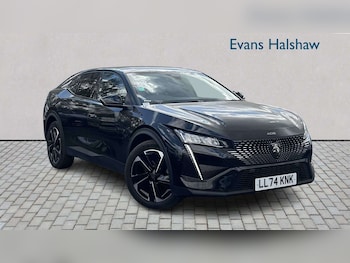
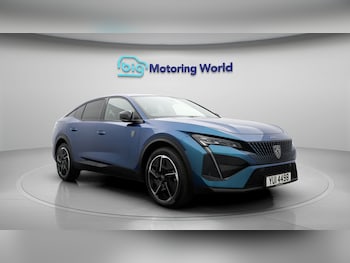
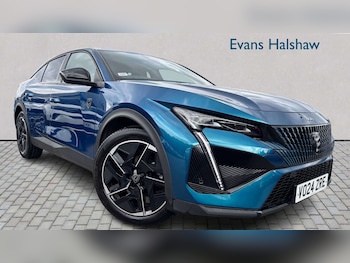
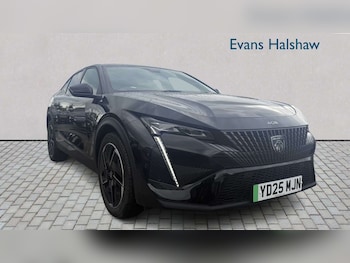
In a sea of samey SUVs, the 408 offers a stand-out look with saloon styling and the high stance and commanding road view of an SUV


Author: Charlie Harvey
7th May 2026 – 10 mins read
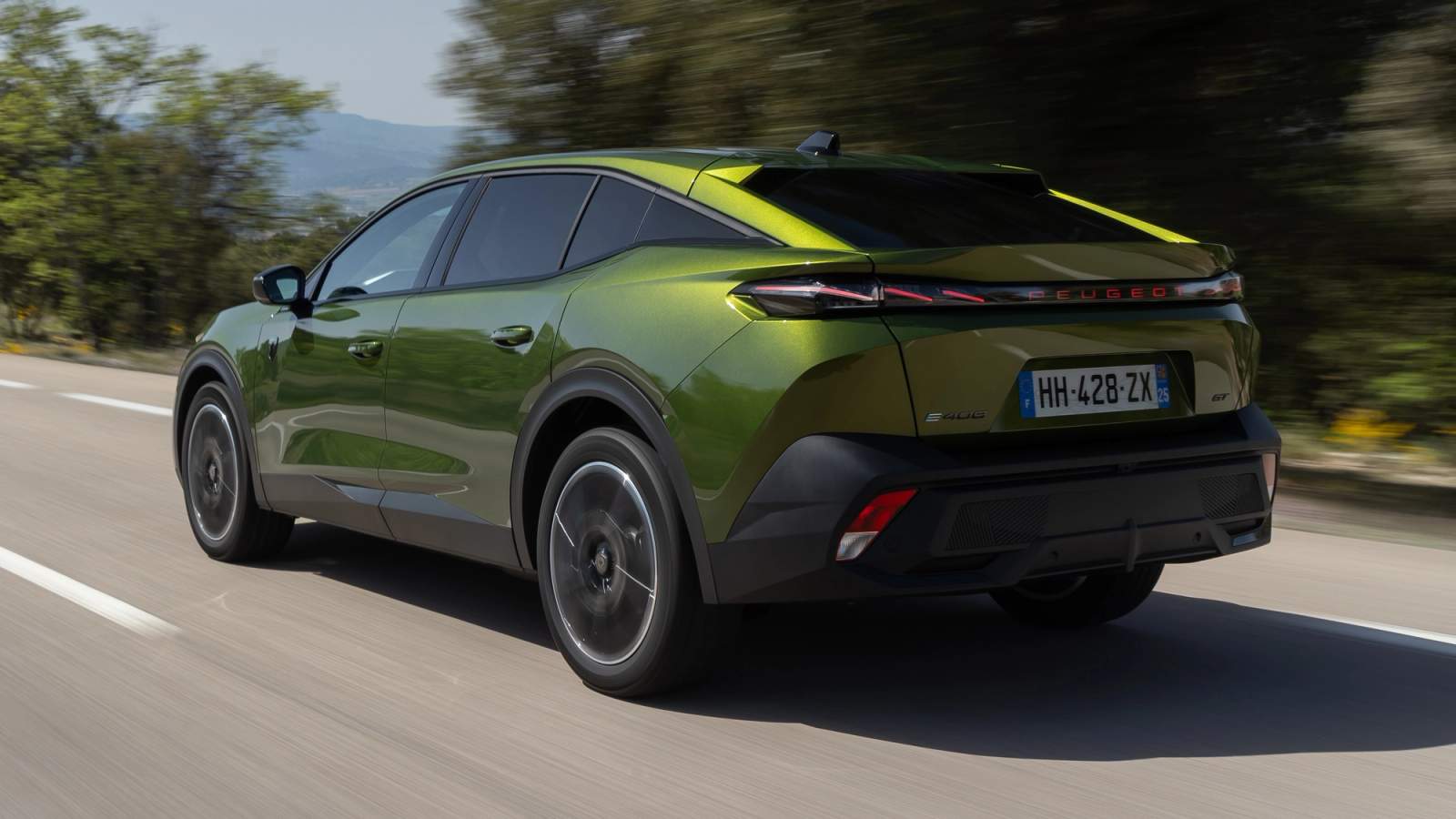
The craze for SUVs has been ongoing for some time now, so UK roads have started to look rather samey. The Peugeot 408 aims to blend the benefits of an SUV, such as a lofty driving position and pothole-smoothing ride, with a saloon-like silhouette that harks back to previous models in the 400 series – despite that, though, it’s actually got a hatchback, which makes more sense for practicality. Those benefits, plus the wide range of fuel types, means many motorists will get along very well with the 408 – our pick is the electric E-408 because it’s much more refined than the hybrids, and is priced well on both the new and used market. The facelift has added some stylish upgrades, but the basic recipe is still the same. A few other car manufacturers have had the idea to blend the SUV body style with other car designs, so if you want another car that stands out from the crowd you might consider the 408’s rivals, including the Renault Arkana, Toyota C-HR, Cupra Formentor or Citroen C5 X, as well as premium models like the BMW X2 or Audi Q3 Sportback. The Peugeot 408 sits in a space between mainstream and premium models, with the brand currently on a mission to present itself more high-end than in its recent history.
Pros
- E-408 offers the best, most refined driving experience
- Spacious rear seats
- Striking standout design
Cons
- Plug-in hybrid doesn’t feel as powerful as on paper
- Small blemishes in the road can upset the ride
- Steering feels artificial and unnatural
Interior:
Dashboard & tech
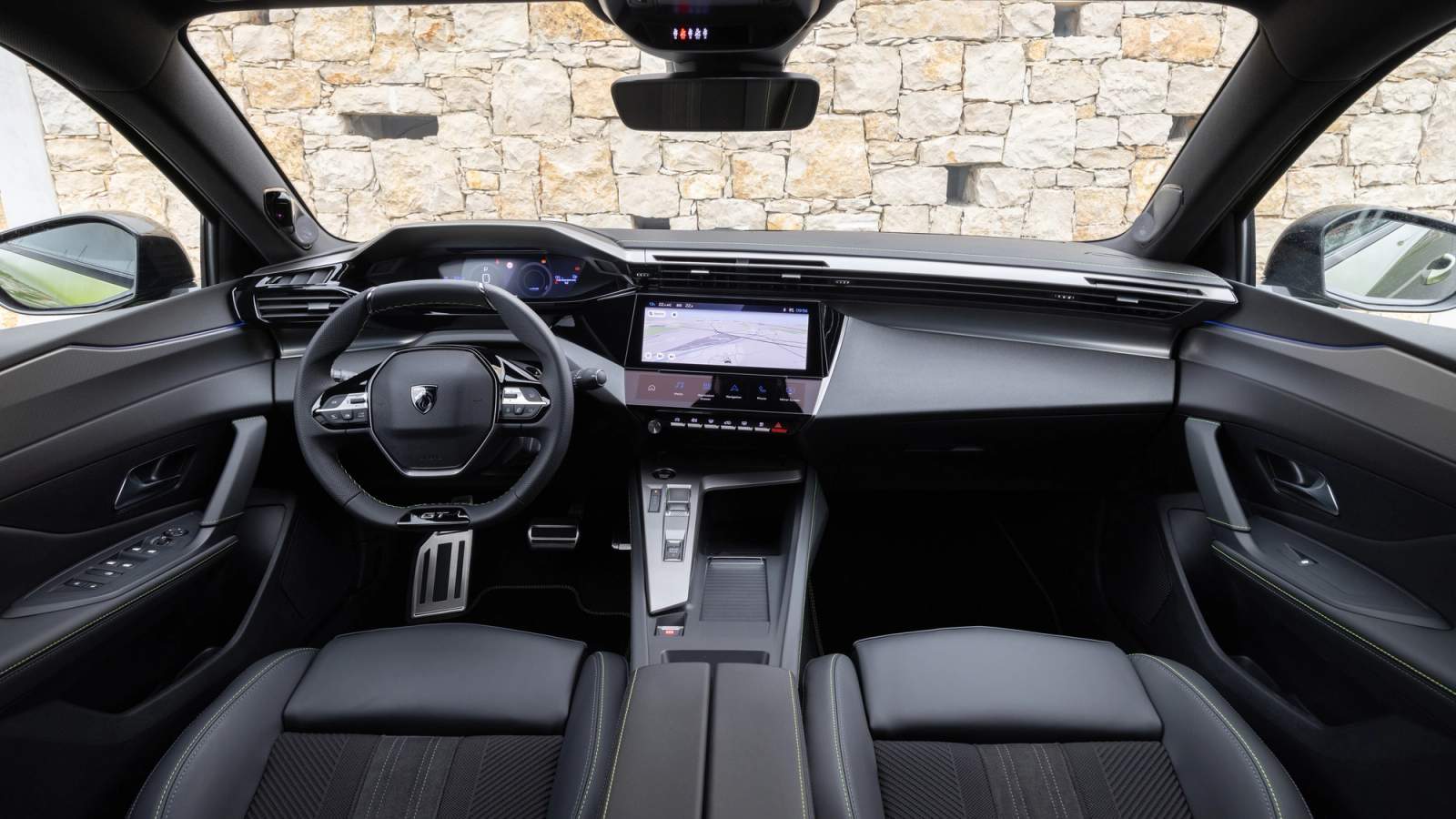
First thing’s first – if you’re unfamiliar with Peugeot’s iCockpit dashboard layout, you might find the Peugeot 408 takes a bit of getting used to from the driver’s seat. The unconventional design comprises a small stubby steering wheel and a high instrument binnacle which means that rather than looking through the gap between spokes to see your speed and readouts, you look over the top of the wheel. Some will like this quirky feature, though it’s not for everyone – either way, we recommend you check it’s to your tastes when you go for a test drive.
As a general rule, the Peugeot 408 offers a premium feel considering its market positioning. To a large extent it’s been successful, as soft plastics and smart finishes make things feel high end, but only high-spec GT Premium models get electrically adjustable seats – without them the 408 can feel cheap when you have to tweak your driving position manually, but if you’re the sole driver you’re only going to be doing that once in a while.
Every trim feels well equipped when you consider the price – the range starts with Allure, moving up through GT and GT Premium grades. As standard you get LED headlights, the 10-inch Peugeot iCockpit instrument cluster, a rear parking camera and sensors alongside other useful features. If you can go for a GT model, you’ll get the fancy illuminated grille, matrix LED headlights, a useful electronically-operated boot and added driver assistance tech. GT Premium models get Alcantara for a more premium interior feel, an impressive Focal sound system, 360-degree parking camera and a heat pump on E-408 models (this helps keep the battery operating at an optimal temperature in colder months, preserving range.)
Comfort
We tested the 408 in all its various guises, from the mild-hybrid to fully-electric and plug-in hybrid models. There was a noticeable difference in the ride quality on these different models, due to their differing weights and suspension setups. We preferred the electric E-408’s ride – somehow it felt more communicative through the wheel and yet still comfortable, as well as composed. The weight of the batteries in the floor stops the E-408 jiggling around and ‘floating’ compared with its lighter combustion-engined counterparts. Our main criticism was that minor blemishes at lower speeds seemed to send shudders through the cabin at points, upsetting the otherwise serene atmosphere. We tested the 408 on well-maintained roads in Marseille, France, but this could rear its head on pothole-riddled UK roads.
Quality
Peugeot has been aiming for a more premium look and feel to its range in recent years, and we’re happy to report that the 408 mostly accomplishes that brief. Stepping into the 408 feels rather special initially, and everything is nailed down solidly. On the move there were no creaks or rattles in our test cars, and you’d be forgiven for thinking you were riding in a German-made model.
For the most part, the material choices in the 408’s cabin are high quality, but there are areas that let it down. While the shiny piano black finish around the infotainment screen looked ok on our test car, we’d imagine that could start to look grubby very quickly after a few prods from a greasy finger, and could scratch easily. Bear this in mind when shopping around and check you’re happy with the finish here.
Practicality & boot space:
Interior space
Don’t be fooled by its saloon-like silhouette – the Peugeot 408 is a rather large car in the metal. Despite that, large modern cars – especially EVs – can then feel disappointing when you step inside as they’re robbed of space to accommodate crumple zones and a thick outer shell designed in the name of safety. The 408 is not too bad in this respect – we expect passengers seated in the rear of the car will feel particularly comfortable as there’s lots of legroom. The rear floor is slightly recessed even in the E-408, which was a pleasant surprise – the placement of large batteries in EVs can often mean there’s a high floor, and passengers sit with their knees up to their ears as a result, but that’s not the case in the E-408 – Peugeot has been clever with this car’s packaging.
Despite the sloping roofline, we were impressed by the rear headroom, too, so the good news is that you won’t feel the swoopy looks have led to compromise compared with a boxier, fully-fledged SUV.
The Peugeot 408 has ISOFIX points on the rear two outer seats, so mounting a child seat should be no issue. Because of the high ride height, the 408 is easy to step into and place your children in.
Boot space
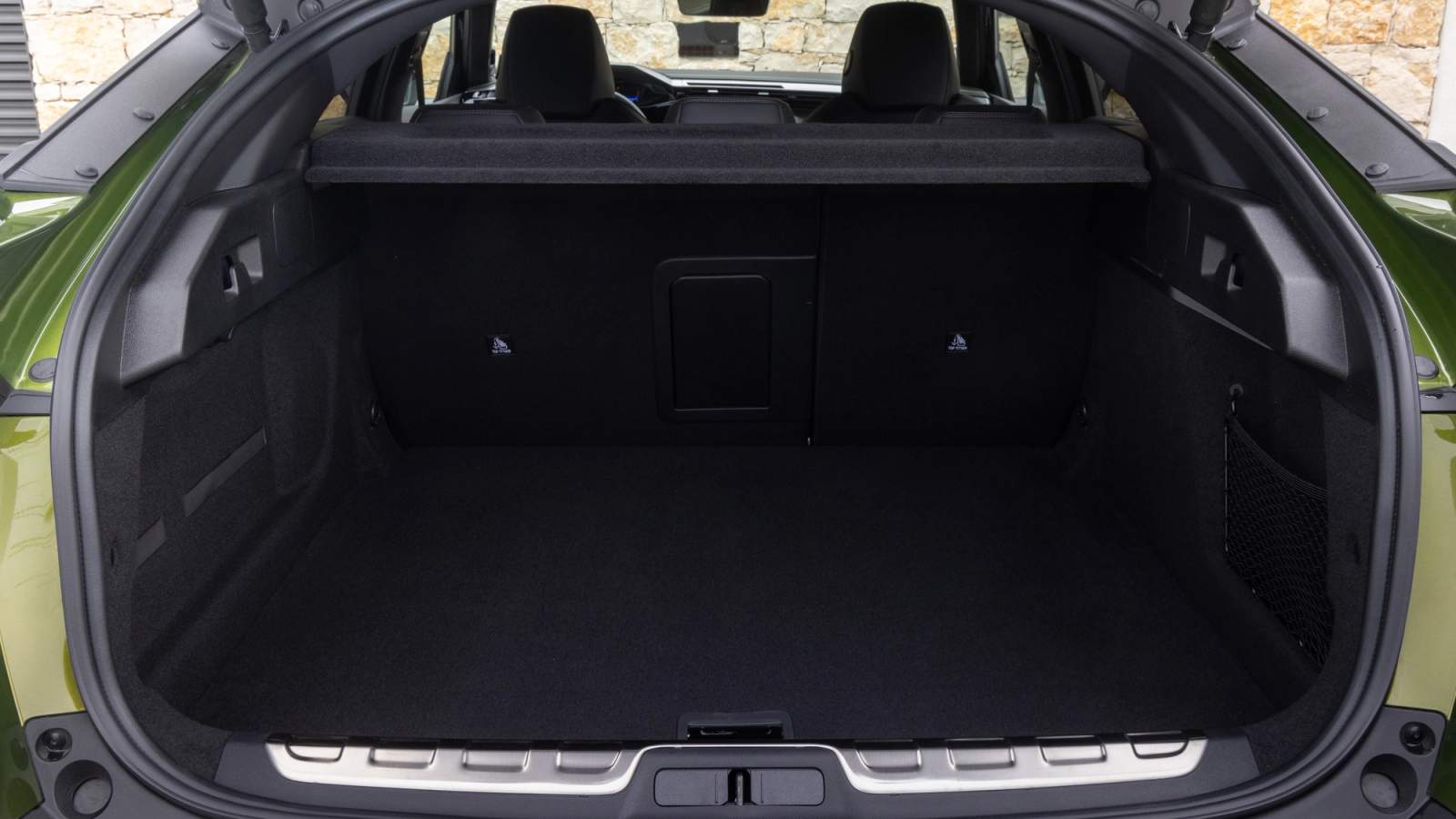
We’re splitting hairs here, because while the boot will be big enough for most buyers’ daily needs, it’s smaller than you’d expect of such a large car – that’s true really of any modern model, however. Boot space depends on the fuel type, as the systems take up different amounts of space. The entry-level mild hybrid has the biggest boot at 536 litres. The electric E-408 has the second-biggest boot with 468 litres, while all the gubbins in the plug-in hybrid car means it has just 415 litres on offer. As with most cars, you can fold down the rear seats to free up more space for occasional larger loads like flat-pack furniture. If you want to pack a few suitcases for a trip, and a car-load of passengers, look elsewhere.
Versatility
While most would be happy enough with a base model Allure, it’s definitely worth considering the GT model for added ease and practicality – these models get an electronically powered tailgate, but you’ll have to spring for a GT Premium example if you want a foot-operated powered tailgate, which makes loading and unloading much easier if you’ve got your hands full.
There are a few useful cubbies in the car’s cabin, but no more than the average family car. We like the way the centre armrest splits down the middle to open up, because it means the lid doesn’t get in the way and is easily accessed from either side.
Driving:
Driving experience
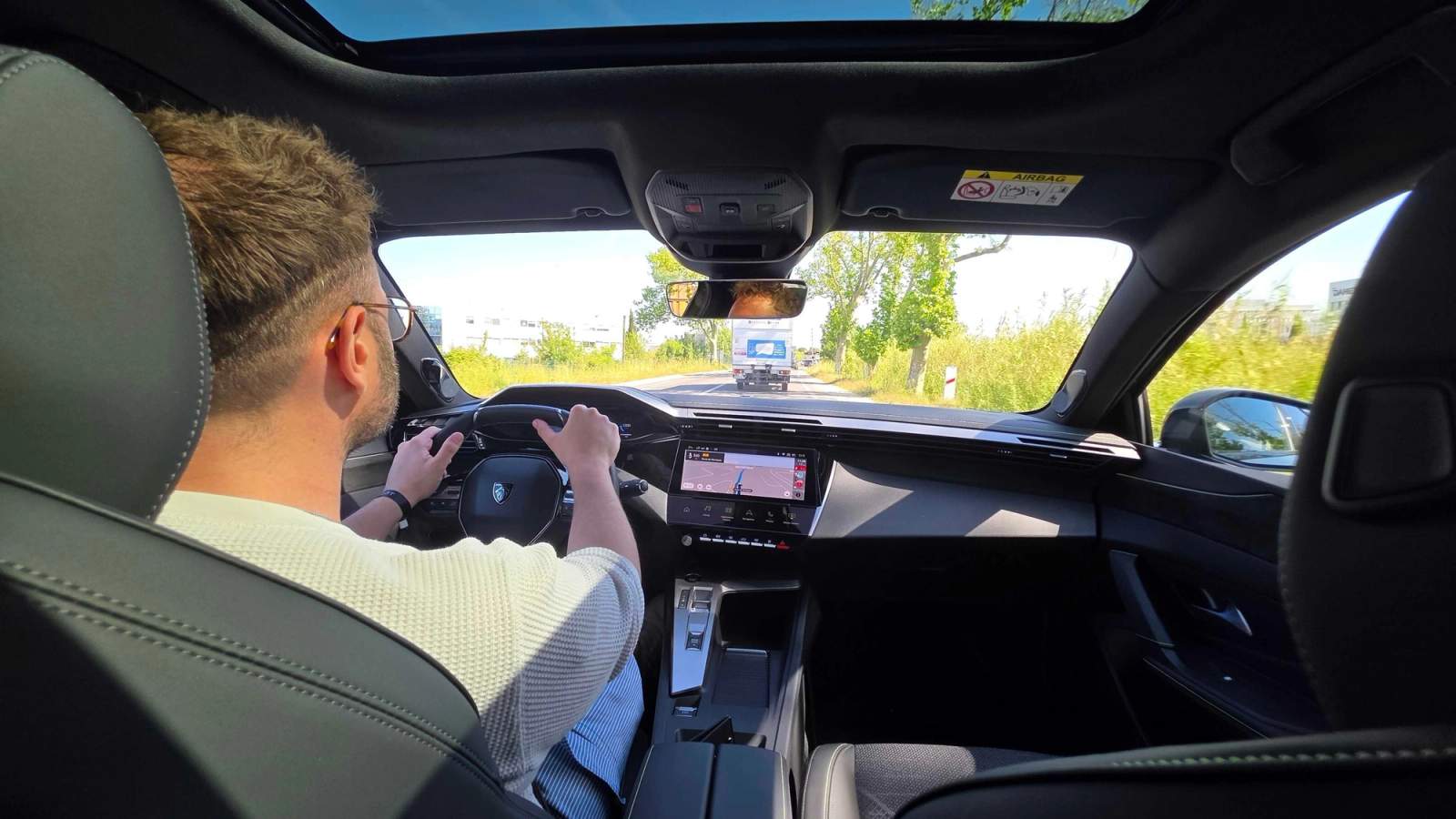
If you’re looking for excitement, the 408 isn’t really the car for you – we admit, however, that’s not the goal for most buyers. We tested all three versions of the 408, and found the electric E-408 to be the best to drive. That’s not solely down to the smooth power delivery offered by its electric motor, but also how that setup makes it sit on the platform – while it’s the heaviest of the three options, it sits well on the road, giving a better feel through the wheel. Despite that, it’s not uncomfortably hard as some heavy electric SUVs can feel.
Conversely, the mild hybrid Hybrid 145 model is a little bouncier and feels more numb to drive, though it’s still comfortable enough. The plug-in hybrid also feels a little floatier compared with the EV, so while that model may be the most powerful and quickest of the three on paper, don’t expect it to feel sporty through the wheel.
One low point of all models is the steering – the electric power steering feels rather artificial, as if the system is tugging the wheel away from you with an elastic band. For most this might not be noticeable, but it’s worth bearing in mind if you’re an avid driver when you take one for a test drive.
The upshot is that the steering is light at lower speeds and when manoeuvring, and doesn’t feel so light that you can’t place it when parking. The high stance can take some getting used to in tight spaces, but a reversing camera and parking sensors do take some of the stress out of the process.
Performance
On paper, the plug-in hybrid is the most powerful of the three models with 237bhp, but that’s not to say it’s the fastest. The E-408 has a relatively more modest – but still more than adequate – 207bhp, but is actually the quickest of the three models from 0-60mph, taking 7.2 seconds compared with the plug-in hybrid’s 7.5-second figure. Those are both rather leisurely figures, however. Peugeot has calibrated the EV in such a way that it won’t rip your face off when you put your foot down, which makes for a relaxing, rather than aggressive driving experience.
There wasn’t a particularly noticeable difference when switching between ‘Normal’ and ‘Sport’ drive modes, though ‘Eco’ does feel noticeably less powerful in the EV. In the plug-in hybrid, there’s no particular benefit to ‘Sport’ – it merely keeps the petrol engine running and ready when you put your foot down, but in practice it sounded gruff and didn’t feel particularly spritely.
Predictably, the mild-hybrid petrol’s 143bhp propels it from 0-60mph more leisurely, taking 9.4 seconds. In our experience, however, it never felt underpowered, and if you’ve not got a place to charge an EV or plug-in hybrid, many buyers will consider it perfectly adequate for their needs.
The E-408 offers a few degrees of adjustment to the regenerative braking system – at its strongest setting, it uses the motor – rather than the brakes – to slow the car down briskly when letting off the accelerator, while feeding some of the energy lost during conventional braking back into the battery to save range. It’s a useful feature on many EVs, but if you want a more conventional driving experience, you can turn this right down and use the brake pedal.
In some EVs, the most aggressive setting allows for ‘one-pedal driving’, where you don’t have to touch the brake at all as letting off the accelerator brings you to a complete stop, but that’s not present in the E-408 – fans of that feature coming from another EV might be disappointed.
Running costs:
Fuel economy & CO2 emissions
Since its inception, the 408 has been available with a wide range of fuel options, which is great for buyers because they can find one that will fit into their lifestyle.
The Hybrid 145 model (more of a mild-hybrid in practice) runs on a small tried-and-tested 1.2-litre petrol engine that’s supplemented with electric assistance. As a result, it’s very frugal, with a fuel economy figure of around 47mpg and CO2 emissions of between 113 to 116 g/km.
While the plug-in hybrid sounds impressive in terms of fuel economy on paper, with lofty figures of around 109mpg, that’s not really the full story. To achieve that figure you’ll have to keep the plug-in hybrid’s battery charged up, because as soon as it depletes, you’ll be running solely on its 1.6-litre petrol engine while carrying around the dead weight of the battery – in that scenario you’re likely to do worse mpg than the standard mild hybrid. Peugeot says the 408 plug-in hybrid will do up to 53 miles in electric mode, which should be enough to commute to and from the office in theory, but take that figure with a pinch of salt.
The plug-in models are aimed mainly at new company-car buyers as the low on-paper CO2 emissions figures of between 56-60g/km make them eligible for significant tax breaks, as well as the zero-emission E-408. If you’re considering a used 408, there’s much less of a case for the plug-in hybrid, especially if you lack a home wallbox charger to benefit from lower charging costs.
The E-408 EV’s on-paper combined range is 283 miles – that’s likely to be adequate for most buyers, but expect the real figure to be about 20% less. A heat pump is optional (standard on GT Premium), so it’s worth specifying one or finding a model with one fitted if buying used – it keeps the battery at an optimal operating temperature in the winter months, helping to preserve range. Our experience driving the E-408 in Marseille proved the quoted range to be pretty accurate, but this was on a sunny, moderate day in spring.
The E-408 EV has the potential to be the most attractive choice here if you have your own driveway or a means to charge it cheaply via a home wallbox charger on a cheap electricity tariff to dodge ever rising petrol prices. Again, the benefits will be less evident if you still have to charge at public stations, but the E-408 is actually not the most expensive version in the range to buy new (it sits below the plug-in hybrid in terms of price), and is the best version of the 408 even aside from fuel costs anyway – it’s also pretty affordable on the used market now, so we think it’s the one to go for.
Reliability & warranty
While French brands in the UK have suffered from a bad reputation for reliability in the past, that’s not really deserved these days. We’re yet to hear of any horror stories regarding the electric motors and engines used in Peugeot’s range and those used across parent-company Stellantis’ brands (including Citroen, Fiat, Vauxhall, Alfa Romeo among many others).
Peugeot vouches for its own cars, so while the standard manufacturer warranty is 3 years, regularly servicing your Peugeot annually within the service schedule will keep that warranty valid for up to an additional 5 years, or when the vehicle hits 100,000 miles, whichever comes first. That also transfers between owners, so if you’re buying used, check the 408 you’re looking at has met the conditions to still be under warranty, as it’s great for additional peace of mind.
Safety:
Safety features
The Peugeot 408 comes with safety kit such as autonomous emergency braking, Peugeot SOS and assistance, lane keep assist, a speed limiter, traffic sign recognition, driver attention alert, seatbelt unfastened alert, and handy convenience tech such as adaptive cruise control as standard in Allure trim. GT models and GT Premium currently get lane centring assist in addition to the aforementioned kit, while GT Premium gets blind-spot detection. Standard specifications may vary on pre-facelift cars, so if you’re buying an older model, check it’s got everything you’re looking for in terms of safety equipment.
Trims & engines:
Trim levels
The Peugeot 408 and E-408 is available in three trims: Allure, GT and GT Premium
- Allure: Even base-spec Allure versions of the 408 have most of the things you’d conceivably want. Most notably, however, you miss out on the styling light signature built into the front grille, but you do get useful tech like LED headlights, the 10-inch infotainment screen and instrument panel, tinted windows, Apple CarPlay and Android Auto, climate control, acoustic laminated front windows for better sound-deadening, rear parking sensors, a heated steering wheel, keyless entry and go among other features
- GT: While you might be happy with Allure, GT does add some extra style and presence with the front grille lighting, matrix LED headlights with elegant sequential ‘scrolling’ indicator lighting, plus that handy electric tailgate, and a configurable touch screen below the infotainment where you can customise shortcut buttons.
- GT Premium: GT Premium gets electrically adjustable seats, a 3D instrument panel, a 360-degree camera, foot-operated electrically powered tailgate (handy when you’ve got your hands full), wireless smartphone charging, Alcantara interior trim, and an impressive premium FOCAL sound system. On E-408 models you get a heat pump in this trim – that’s probably worth it alone, given it preserves electric range by keeping the battery at optimal operating temperatures in the colder months.
Engines
The Peugeot 408 is pretty versatile in terms of engine and fuel type choices. You can get it with the base mild-hybrid Hybrid 145 with a 1.2-litre electrically-assisted petrol engine. The next step up is the E-408, which uses a 207bhp electric motor which has remained the same in pre-facelift and post-facelift versions. Finally, there’s the plug-in hybrid, which is the most powerful option with 236bhp – in all honestly you won’t notice the increased power, and it’s actually not quite as quick in a straight line as the E-408.