Guide to driving in the USA: what you need to know
With the World Cup round the corner, thousands of football fans will soon be packing their bags and travelling across the Atlantic. If you are planning to follow the tournament, or simply taking a holiday alongside the matches, getting around will likely involve a hire car. American roads are vast, and while the prospect of tackling a multi-lane interstate might feel daunting, a little preparation goes a long way.

Charlie Harvey
Published on 27 May 2026 | 7 mins read

This comprehensive guide to driving in the USA will walk you through the key differences between driving in the UK and America. By the end of this article, you should feel confident, prepared, and ready to navigate everything from four-way stops to giant American highways.
The Basics: Adjusting to the American Road
When you first sit in your American hire car, everything will feel back to front. Taking a few moments to familiarise yourself with the setup will make your first drive significantly less stressful.
Driving on the Right and Left-Hand Drive Vehicles
In the USA, you must drive on the right-hand side of the road. This means the steering wheel is on the left side of the car. You will need to change gears (if applicable) and operate the handbrake with your right hand, while your left hand stays on the steering wheel. The pedals remain in the same order as a UK car, but the indicator and windscreen wiper stalks might be swapped.
Quick tip: When turning onto a new road, particularly an empty one, consciously remind yourself to turn into the right-hand lane. Repeating "keep right" under your breath during the first few days is a highly effective strategy.
Getting Used to Automatic Cars
The vast majority of hire cars in America are automatic. If you’re used to a manual gearbox, driving an automatic requires a slight physical adjustment. Your left foot has nothing to do. If you instinctively use your left foot to press a non-existent clutch, you’ll likely hit the extra-wide brake pedal and perform an emergency stop. Keep your left foot tucked firmly against the footrest to prevent this.
Navigating Intersections and Traffic Rules
American junctions operate under slightly different rules to British crossroads and roundabouts. Understanding these mechanics is vital for staying safe.
Right Turn on Red
One of the most surprising rules for UK drivers is the "right turn on red". In most parts of the USA, you are legally permitted to turn right even when the traffic light is solid red.
To do this safely, you must come to a complete stop at the junction. Check for pedestrians and oncoming traffic from the left. Once the way is clear, you can proceed with your turn. However, you must look out for signs that explicitly state "No Turn on Red". Be aware that in New York City, turning right on red is entirely prohibited unless a specific sign allows it.
The Four-Way Stop
Where British towns rely on roundabouts, American towns use four-way stops. You will see a standard red octagonal "STOP" sign with a smaller "4-WAY" or "ALL WAY" plaque underneath.
The rule here is simple: the first vehicle to arrive at the junction and stop is the first vehicle allowed to proceed. You must come to a complete halt. If you arrive at exactly the same time as another vehicle, the car to your right has the right of way. Eye contact and a polite wave are incredibly helpful in these situations.
Road Signs and Traffic Lights
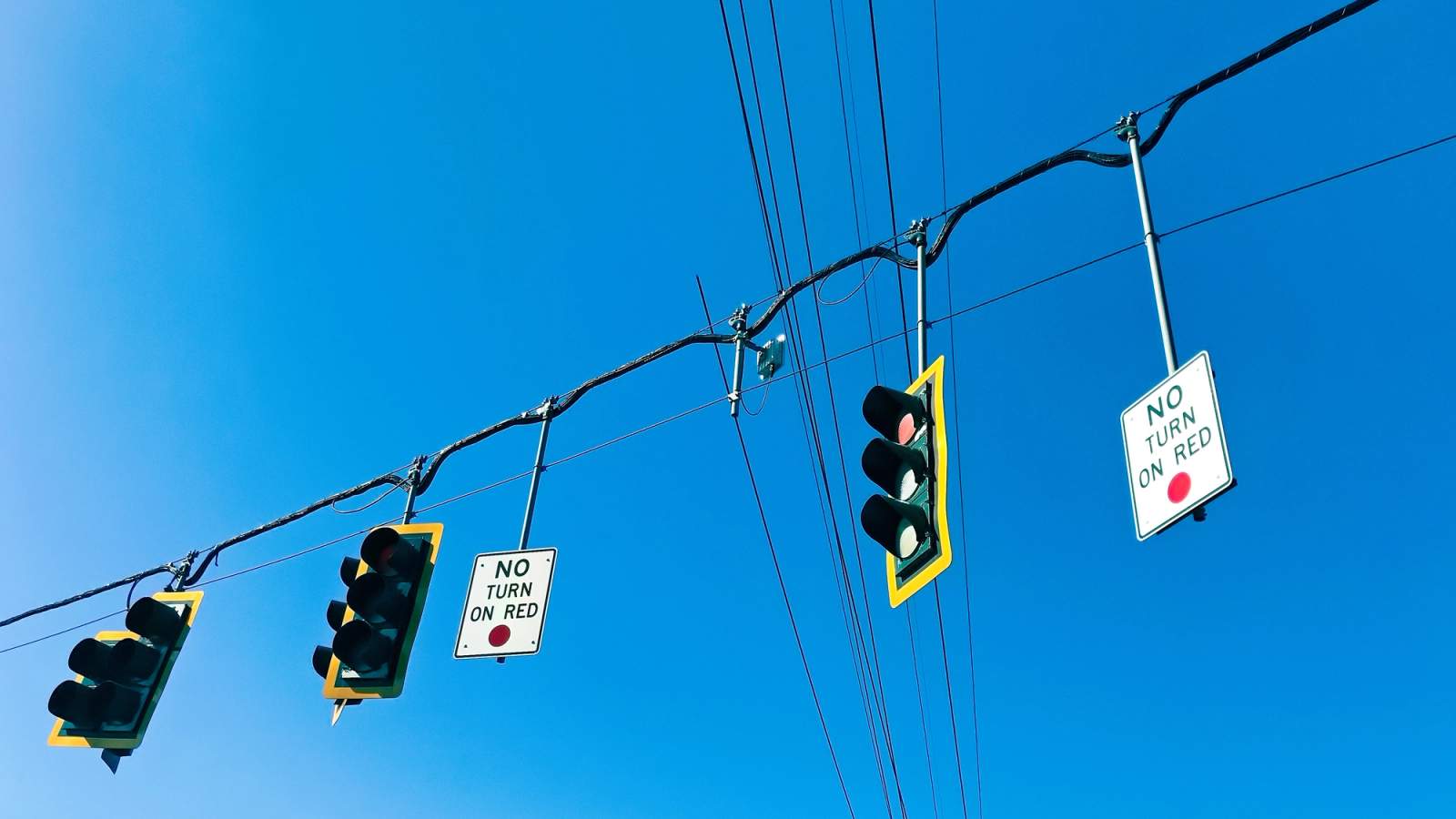
American traffic lights are often suspended on wires directly above the middle of the junction, rather than placed on posts at the side of the road. Stop well behind the painted white line at the junction entrance so you do not have to crane your neck upward to see the lights change.
Road signs are generally text-based rather than symbol-based. Instead of a red circle with a line through a U-turn symbol, you will often just see a sign reading "NO U TURN".
On the Open Road: Speed and Lane Etiquette
American highways are wide, busy, and operate under slightly different etiquette to British motorways.
Speed Limits and State-by-State Variation
The good news for UK drivers is that the USA also measures speed and distance in miles per hour (mph). You do not need to mentally convert kilometres.
However, speed limits vary significantly from state to state, and even county to county. Highway speeds usually sit between 65 mph and 75 mph, though some western states permit 80 mph. Always rely on local signage rather than assuming a national standard. Furthermore, traffic laws, fines, and enforcement methods are determined at the state level. What is a minor infraction in Florida might carry a hefty penalty in California.
Undertaking and Overtaking
In the UK, undertaking (passing on the left) is strongly discouraged. In the USA, passing on either side is incredibly common and perfectly legal on multi-lane highways.
Because Americans refer to the left lane as the "fast lane" or "passing lane", slower drivers are supposed to keep right. In practice, drivers stick to their chosen lane, and faster traffic simply weaves around them. You must check your wing mirrors and blind spots constantly on both sides when changing lanes, as vehicles will frequently overtake you on the right.
Sharing the Road Safely
Protecting vulnerable road users is a priority everywhere, but the USA has specific laws regarding buses and pedestrians that you must obey strictly.
The Golden Rule: School Buses

American school buses are bright yellow and heavily protected by law. If you see a school bus stopped with its red lights flashing and a "STOP" sign extended from its side, you must stop completely.
Crucially, this applies to traffic travelling in both directions. You cannot pass a stopped school bus until the flashing lights turn off and the stop sign is retracted. The only exception is if you are travelling in the opposite direction on a divided highway separated by a physical central reservation or barrier. Failing to stop for a school bus carries severe legal penalties.
Pedestrian Priorities
Pedestrians have the right of way in marked crosswalks (zebra crossings). In many states, they also have the right of way at unmarked intersections. Always yield to pedestrians when you are turning, especially when making a right turn on a red light. Be aware of "jaywalking" rules; pedestrians are supposed to cross only at designated points, but as a driver, your responsibility is always to stop and prevent an accident.
Practicalities: Parking, Tolls, and Legalities
Getting the administrative side of your trip sorted will save you time and money during your holiday.
Parking Rules
When parking on an American street, always park in the direction of traffic flow. If you park facing oncoming traffic, you will receive a ticket.
Pay close attention to kerb colours:
- Red kerb: No parking at any time.
- Yellow kerb: Loading zone only.
- Green kerb: Short-term parking (check signs for time limits).
- Blue kerb: Disabled parking only.
Never park within 15 feet of a fire hydrant. Your vehicle will be towed away immediately, and the fines are extortionate.
Navigating Toll Roads
Many major highways and bridges in the USA are toll roads (often called turnpikes). Cash booths are becoming increasingly rare. Most toll roads now use electronic scanning systems like E-ZPass, SunPass, or FasTrak.
When you collect your hire car, ask the rental company how they handle tolls. Many companies offer an electronic toll transponder for a daily fee. If you decline it and drive through an electronic toll gantry, the rental company will charge your credit card for the toll plus a hefty administrative penalty.
Insurance and Required Documentation
To drive a hire car in the USA, you need your full, valid UK driving licence (the photocard). While not strictly legally required in every state, carrying an International Driving Permit (IDP) is highly recommended as a backup. You should also keep your passport handy as a secondary form of photo ID.
Insurance is vital. Ensure your hire package includes Collision Damage Waiver (CDW) with zero excess, and Supplemental Liability Insurance (SLI). American medical and legal bills are astronomical, so comprehensive liability cover (ideally up to $1 million) is essential.
Drink-Driving Laws
The legal blood alcohol limit in the USA is 0.08%, exactly the same as in England, Wales, and Northern Ireland. However, enforcement is incredibly strict.
The USA also enforces "Open Container Laws". It is illegal to have any open container of alcohol inside the passenger cabin of the car, even if it belongs to a passenger and the driver is completely sober. If you are transporting a half-finished bottle of wine from a restaurant, it must be stored in the boot (trunk) of the car.
Practical Safety Tips for UK Visitors
- Plan your route before setting off: Interstates have frequent exits, and changing lanes at the last minute across four lanes of fast-moving traffic is dangerous.
- Keep your distance: American cars, particularly trucks and SUVs, are much larger and heavier than European vehicles. Leave plenty of braking distance.
- If you get pulled over by the police: Pull over safely, turn off the engine, roll down your window, and keep your hands clearly visible on the steering wheel. Do not reach into the glovebox for your documents until the officer explicitly asks you to do so.
- Fuel up early: Distances between petrol stations (gas stations) in rural America can be vast. Do not let your tank drop below a quarter full.
Summary
Driving in America offers incredible freedom and is often the best way to experience the country. While the roads, vehicles, and rules differ from the UK, the adjustment period is usually very short. Remember to stay focused on keeping to the right, respect the school bus laws, and keep an eye out for vehicles passing on both sides. Prepare your documentation in advance, familiarise yourself with the local state laws of your destination, and enjoy the drive.